
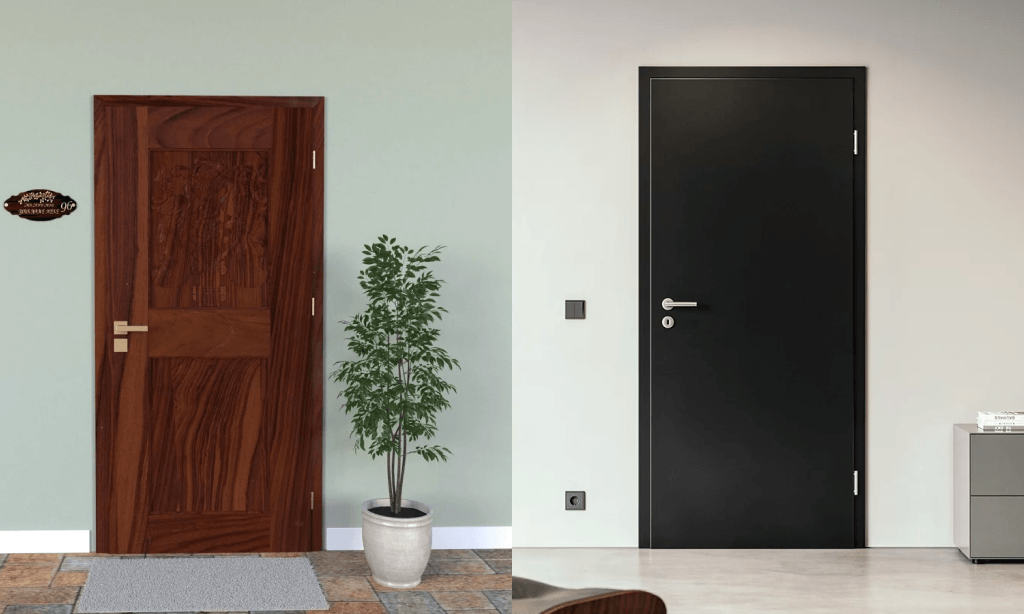
The performance and durability of a door doesn’t just depend on the choice of material, but also how the doors are manufactured, and how they withstand weather fluctuations, especially in locations receiving heavy rainfall. This is where the choice of material comes into play and one compares between a solid wood door vs engineered wood door.
Understanding Material Behaviour in Indian Conditions
A traditional solid wood door is manufactured using single or multiple sections of natural timber, and often constructed keeping the frame and door shutter as separate elements. While this provides desired strength and a natural grain finish, there is also a possibility of the door absorbing moisture depending on surrounding humidity given its hygroscopic nature. This makes the door warp, swell, or shrink over a period of time.
Factory fitted engineered door from Wesmarc Doors are crafted using several layers that includes solid core, cross-banded veneers, and stabilising substrates bonded together under controlled pressure and temperature providing a durable structure. This cross-directional layering minimizes internal stress and retains the structural stability of the door even in challenging climates.
Structural Stability and Longevity
Engineered doors from reputed brands like Wesmarc Doors are crafted using superior quality materials and advanced technology ensuring the doors retain their structural integrity, are durable, with uniform finish.
In contrast, engineered wood doors are designed with calibrated density and uniform composition. They are also designed with consistent load-bearing capacity, are resistant to moisture and come with sealed edges using water resistant adhesives. This prevents water ingress unlike traditional solid wood.
When comparing solid wood internal doors with engineered wood options, a factory fitted engineered door provides better resistance to long-term deformation making them apt for use in internal applications where alignment and smooth operation is essential.
Surface Performance and Finish Retention
Another aspect that is looked into when comparing both engineered and solid wood is the durability and how the surface finish is retained over a period of time. Solid wood doors appear visually elegant and rich, require frequent polishing and sealing to protect against moisture and UV exposure. The surface finish can however fade, crack or develop uneven textures over a period of time.
Engineered doors are finished with factory-applied laminates, veneers, or protective coatings. Factory fitted doors from Wesmarc are manufactured using superior quality materials under controlled precision environment, resulting in doors that have uniform finish, smooth edges, and are durable to withstand structural integrity even when used heavily. This is one of the main engineered wood door benefits making it an ideal low-maintenance solution without compromising on appearance.
Cost vs Lifecycle Value
The solid wood door price may often appear fair given the visual appeal they provide, but when considering maintenance, repairs, and potential replacement requirements, factory fitted engineered doors are more ideal. The engineered wood door price is relatively more stable, and is lower than solid wood when considering its durability, with resistance to moisture, UV rays and are easy to maintain.
Performance in Indian Home Applications
Engineered doors perform better in comparison to solid wood, especially in areas where there is constant presence of moisture and high heat like in kitchens, bathrooms, and main entrances. Engineered wood withstands presence of moisture and resists swelling and warping.
Solid wood doors are ideal for use in areas of a home where there is less moisture like in bedrooms and living rooms. When choosing a door, it is essential to not just consider the wooden door price, but also environmental compatibility of the material.
When it comes to doors, one always compares solid wood door vs engineered wood doors and often, it is the engineered wooden door that is preferred given its long lasting structural integrity and durability. Engineered doors from reputed brands like Wesmarc are designed to be structurally stable, with the ability to withstand the presence of moisture and high heat. The surface is easy to clean and maintain, requiring no polishing and is ideal for use in Indian homes. These factory fitted doors offer better dimensional stability without warping or swelling, thereby requiring no repairs nor replacements.

