
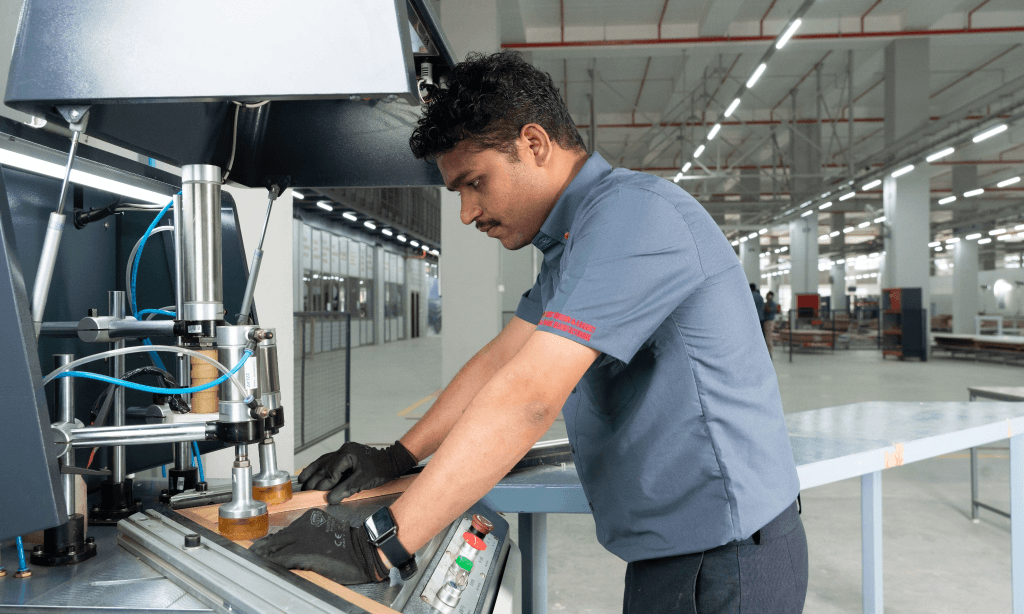
Wooden doors in the modern age are not usually hand-made in carpentry shops. Rather, they are manufactured in modern factories, employing high-tech equipment and rigorous quality testing procedures. Knowledge of how wooden doors are made will help people understand why factory-produced doors are superior to the traditional alternative.
Raw Materials in the Modern Door Production Process
The quality of a door depends very much on the materials used in its production. Reputed manufacturers like Wesmarc doors pay great attention to choosing all components. Wesmarc’s approach combines engineered door construction with carefully selected core materials and factory-controlled production, helping deliver consistent dimensions and long-term stability across different door applications.
| Material | Purpose |
| Engineered Wood / Kiln-dried hardwood | Door frame construction |
| MDF | Composite core filling |
| Block board | Solid-core construction |
| CPL sheets | Decorative surface finish |
| Natural wood veneer | Natural finish |
| Laminate sheets | Budget-friendly surface finish |
| ABS/PVC edge bands | Edge protection |
| Industrial adhesives | Bonding of components |
With the use of Engineered wood, kiln-dried wood and engineered boards, there is greater stability than with regular wood. Thus, the former two materials are crucial elements in the door manufacturing process India adopts in its modern plants.
The Steps involved in Door Manufacturing Process
Here is the answer to how wooden doors are made.
| Step | Process | Equipment Used |
| 1 | Raw material selection & Grading | Inspection tools |
| 2 | Material cutting & preparations | Beam saw / CNC cutting saw |
| 3 | Panel lay up | Glue spreader & Layup fixture |
| 4 | Core Filling (MDF/ engineered core) | Manual + press |
| 5 | Sanding | Sanding equipment with Wide-belt |
| 6 | Calibration (thickness uniformity) | Wide-belt sander |
| 7 | Surface Application (CPL/TDF/veneer) | flat press / Profile wrapping |
| 8 | Rebate & Resize | Double end tenoner |
| 9 | Edge Banding | Automatic edge bander |
| 10 | CNC Cutting (size, grooves, panels, hardware provisions) for door & frame | CNC |
| 11 | Hardware fitment | Manual with power tools |
| 12 | Quality Inspection & Packing | Manual + quality inspection instruments |
This systematic engineered wood door making process ensures consistent quality across every production batch.
Quality Control at Every Stage
Modern factories follow strict inspection procedures throughout production steps rather than checking quality only at the end.
| Quality Check | What Is Verified |
| Material preparations | Proper dimensions |
| Panel & Frame squareness | Accurate assembly for layup and press |
| Door thickness | Uniform calibration |
| Surface adhesion | Strong bonding |
| Edge banding | Secure sealing |
| Dimensional accuracy | Correct size and thickness |
| Visual inspection | Uniform finish, scratches, and air bubbles |
| Weight check | Product consistency |
Door quality control processes ensure each door manufactured is perfect. Take a closer look at the Wesmarc manufacturing facility to see how precision, automation, and zero-dust production come together at scale. At Wesmarc Doors, this factory-controlled approach is supported by precision calibration, consistent surface finishing, accurate edge treatment, and dimensional checks, helping ensure that every engineered door meets the required standards before it reaches the site.
Factory-Made vs Carpenter-Made Doors
The first question many people ask when considering how wooden doors are made is whether factory-made doors have any benefits over carpenter-made doors.
| Feature | Factory-Made Door | Carpenter-Made Door |
| Raw material | Kiln dried and pre-treated engineered wood. | Air dried |
| Accuracy | Machine calibrated | Manual |
| Surface finish | Factory bonded | Hand applied |
| Edge sealing | Machine finished | Manual |
| Consistency | Uniform across all doors | Varies with workmanship |
| Warranty | Manufacturer supported | Usually unavailable |
Factory-made doors offer better dimensional accuracy, finish, and moisture resistance explore the 5 key benefits of engineered doors to understand what makes them a smarter long-term investment over carpenter-made alternatives.
Conclusion
Knowing how wooden doors are made gives you an idea of the advantage of modern technology when it comes to making sure that they will have superior performance. From high quality engineered wood / kiln dried lumber to precision CNC machining, hot press laminating and strict quality inspection – all of these engineered door production steps followed at Wesmarc Doors provides us with an enhanced door system that is long lasting, durable and visually elegant. With features such as factory-finished surfaces, engineered core construction, rebated door profiles, and compatibility with modern hardware systems, Wesmarc Doors brings together precision manufacturing and contemporary door design for residential and commercial applications

