
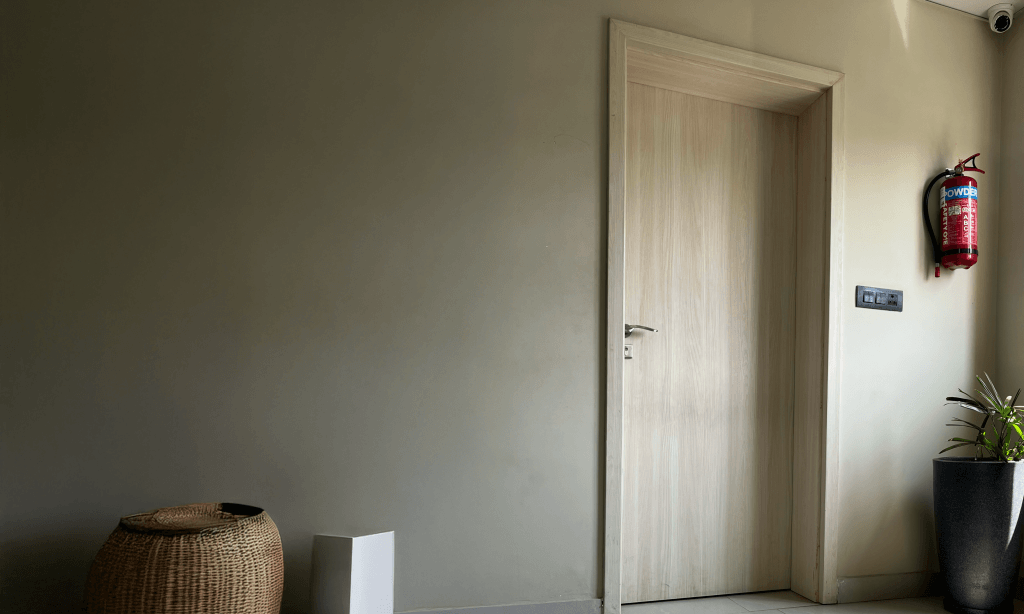
A door in a hotel or hospitality sector isn’t just about visual appeal, but also about withstanding heavy usage and performing at all times. Whether it’s the guest room entrance or service corridors, doors are used heavily withstanding heavy loads and must strictly meet all compliances. This makes it important for architects to not just assess the material selection, but also evaluate hospitality wooden door specifications. Choosing the right engineered wood doors or an engineered timber door system means emphasising on structural integrity, fire safety, acoustic control, and long-term operational stability.
Door Leaf Construction & Core Specifications
The door leaf is the primary, functional and must withstand repeated usage. When it comes to hospitality projects, a solid core engineered construction is preferred.
A well performing engineered wood doors typically consists of:
- Solid core that resists impact due to heavy usage
- Use of cross-banded veneers that minimize internal stress
- Stabilised substrate layers bonded under controlled pressure
With multi layered construction, door leaf remains dimensionally stable even in environments that are exposed to HVAC fluctuations.
For projects requiring engineered premium wooden doors, architects emphasise on:
- Uniform core density across the leaf
- Edge banding to protect against impact and moisture ingress
Frame Integration & Installation Accuracy
In hospitality settings, door performance is heavily dependent on the integration between the door leaf and frame.
Architects often look for:
- Pre-fitted door frames that are designed as complete system with door shutter in line with wall thickness
- Factory fitted, system based engineering of well calibrated shutter-to-frame clearances
- Proper fitment of complete door system to the wall ensuring long term stability and durability
Hinges, Load Distribution & Hardware Selection
A door is opened, closed frequently in hotels, resulting in heavy usage of the hinges that hold the door in its place. A hinge must be carefully designed to withstand heavy usage, ensuring even distribution of the load. The door leaf weight must be such it can bear the load without sagging or misalignment over time.
For this purpose, one must:
- Go for heavy-duty hinges in line with the door weight and height
- Go for equally load bearing hinge configuration for standard doors. Add extra hinges when it comes to taller or heavier shutters
- It is recommended that the hinge is placed to ensure even load distribution along the leaf
Hardware systems must be designed to
- Support smooth swing cycles
- To stay durable and long lasting even with heavy usage
- To perform in sync with the locking systems and door closers
Fire-Rated Performance & Compliance
Safety from fire is very important when it comes to hospitality projects, especially the high rises in today’s times. This is where fire rated commercial doors come in that must meet all compliances, like specified fire resistance durations (typically 30 minutes).
Architects must ideally choose:
- Complete door system including leaf, frames, hardware are fire-resistant
- Ensure there are extruded seals integrated within the frame or leaf edges
Acoustic & Sealing Performance
It is important that noise doesn’t transmit across rooms providing necessary privacy and preventing any disturbances.
To enable these doors to dampen the sound,
- There should be tight tolerance gaps between leaf and frame
- The doors must come with acoustic seals or gaskets
Engineered doors provide tolerance over a period of time unlike solid wood which may expand or shrink, affecting sealing performance.
Surface Finish & Durability
The door must have a surface finish that can withstand heavy usage without losing its finish, and uniformity in terms of thickness over a long period of time.
When it comes to engineered premium wooden doors, architects should consider:
- Choosing laminates or veneer finishes done in the factory.
- Going for doors that offer resistance to scratches and abrasion.
With factory fitted doors, the uniform surface finish can be maintained for a long period of time while supporting long-term durability in high-traffic environments.
Dimensional Stability & Lifecycle Performance
It is recommended to go for engineered wood doors in hospitality applications given their unique advantages. A stable door leaf must:
- Provide smooth operation of hinges and hardware
- Have consistent locking performance
- Be easy to maintain, keeping cost of replacements less.
A door specifically designed for hospitality projects must provide a blend of visual appeal, performance, compliance, and lifecycle efficiency. Choosing a right engineered wood door means paying proper attention to door leaf construction, frame integration, hardware compatibility, and fire-resistance requirements.
Wesmarc provides doors that are engineered as factory finished, system based solutions which enables architects to provide doors of superior, consistent quality, reliable performance, and long- lasting durability across large-scale hospitality developments.

