
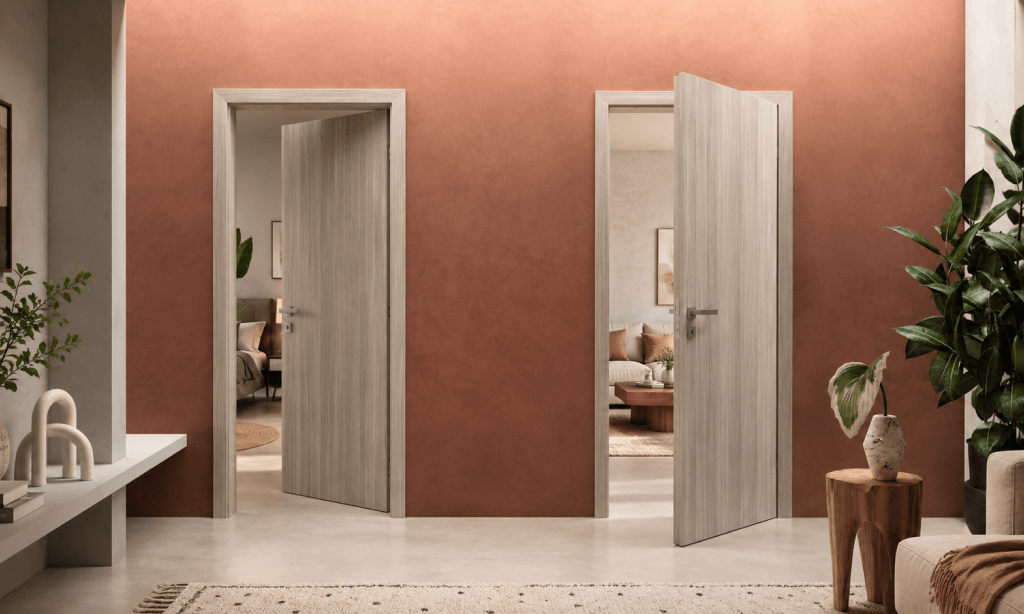
The swing direction of a door determines how efficiently a door can work in a given space and how one can move through the space. Gathering detailed information on different aspects of door handing, opening angles, frame configurations, and clearance requirements enables homeowners and designers to plan the space better. Here is a door swing direction guide that details the door swing direction, space utilization, accessibility, and interior layout.
Understanding Door Swing — Inward, Outward, Left-Hand, Right-Hand
It is essential to understand different door swing terms before choosing the right door.
| Term | Meaning |
|---|---|
| Inward Swing | Door opens towards the room |
| Outward Swing | Door opens outwards from the room |
| Left-Hand Door | Door hinges are placed on left side of the door |
| Right-Hand Door | Door hinges are placed on the right side of door |
| Door Leaf | The movable panel of the door |
| Hinge Side | The side where hinges are installed |
One must know about both left hand vs right hand door India configurations to plan hardware placement, furniture arrangement, and circulation patterns. Engineered wood door systems from Wesmarc can be configured in both left-hand and right-hand directions.
How Room Layout Influences Door Swing Direction
- Furniture Placement: It is always recommended to place the door such that it opens towards the free wall rather than towards furniture and built-in elements.
- Circulation Flow: Make sure the door swing does not obstruct pathways.
- Wall Availability: It is ideal to go for double leaf doors where wall space is lesser.
- Accessibility: If a door system opens up to 180°, it provides clear passage width while enhancing ease of movement.
Room-by-Room Door Swing Direction Guide
Here are some general suggestions of door opening directions for each room one could follow if the room layouts allow for.
| Room | Recommended Consideration |
|---|---|
| Main Entrance | Open towards a clear wall |
| Bedroom | Avoid conflict with furniture placement |
| Living Room | Maintain uninterrupted circulation |
| Study Room | Look for privacy and usable wall space |
| Children’s Room | Keep swing area clear of storage units |
| Kitchen | Avoid door swinging in direction of cabinets and cooking zone |
| Utility Areas | Maximize accessibility and clearance |
| Wardrobes & Storage Rooms | Consider available floor space |
The door swing direction guide also suggests evaluating room dimensions, furniture, and circulation paths refer to the interior door selection guide for a room-wise recommendation on door types and configurations.
Door Swing Clearance: Why It Matters
With proper door swing clearance, the door functions smoothly preventing any space conflicts in the room.
- Preventing Obstructions: Make sure doors open to empty walls and don’t bang into furniture, cabinets, or adjacent walls.
- Maximizing Opening Width: The more the angle of opening, the better the access and flexibility.
- Improving Functionality: Floor space can be used better when there is adequate clearance.
- Supporting Layout Planning: Evaluate the door swing direction when designing interiors and furniture placement to avoid any future space conflicts.
Single-Leaf Vs Double-Leaf Door Configurations
When exploring both single-leaf and double-leaf doors, know first about its features and functionality to make the right choice.
- Single-Leaf Doors: Single leaf door is compact, versatile and ideal for use in all rooms in a home where openings are of standard size.
- Double-Leaf Doors are ideal for larger openings — explore interior door designs for small apartments and homes to understand which configuration works best for compact layouts. They can be used in entrances, living areas, larger spaces
How Hardware Influences Door Operation
Hardware selected plays an important role in determining if to choose inward vs outward door opening configurations.
Key considerations include:
- Position of hardware like door handles and lock
- Hinge position
- Compatibility with door closer
- Essential opening angle
With proper planning of hardware along with door swing direction, door operations can be made smoother.
Conclusion
Selecting the right type of door swing is not just about inward vs outward door opening but also about other attributes like door handing, clearance, room layout, and accessibility all influence functionality. Wesmarc doors offer customizable configurations, 180° opening capability, full wall wrap frames, and integrated hardware solutions ensuring doors adapt well with the space layouts and the interior décor theme enhancing the overall visual appeal of the space.

