
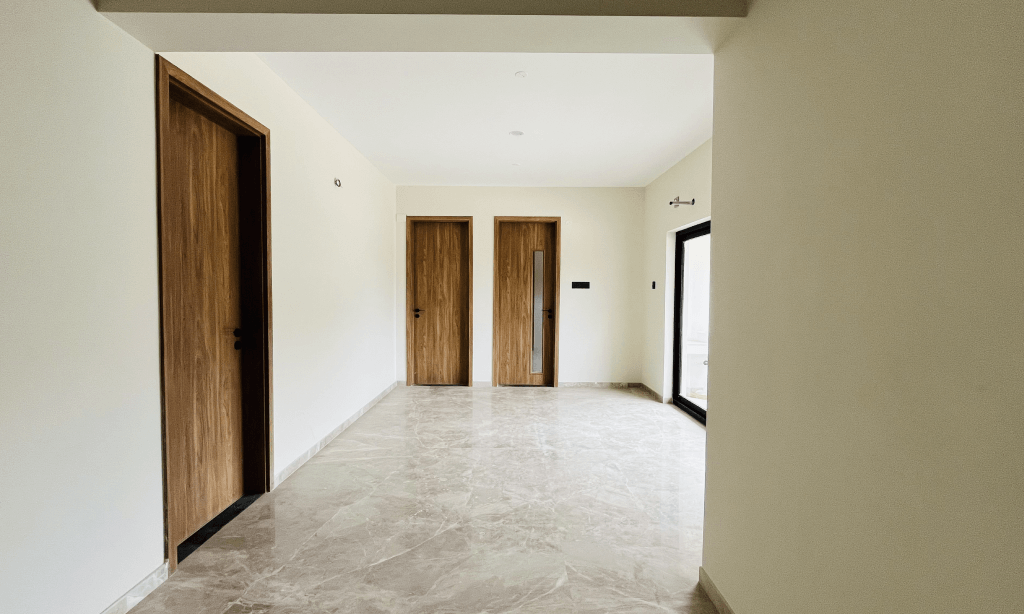
A door isn’t just an accessory that is added at the end of designing, but is an essential part of interior décor theme, to blend well with the space and personality of the residents. With keen focus in today’s times on precision and perfection, a door is designed to be beyond just entry exit and is customized in terms of size to achieve the desired outcome. At Wesmarc, we understand this , and provide the best doors that are designed based on advanced German technology to produce factory fitted doors, with integrated frames, adapting to real construction conditions. This process completely focuses on retaining dimensional structure at all times with long term durability, longevity with no compromise on functionality.
Understanding Standard Door Sizes
Standard door sizes in India are used across various constructions given its easy to predict what the size should be, its efficiency and commonality in use, thereby reducing the effort in architectural planning, minimizing manufacturing timelines without increasing on-site dependency or execution risk. They are a practical choice when supported by tolerance-engineered systems that are designed to work with real-world deviations.
Why Standard Sizes Work Better Today
When it comes to construction, most often the walls are not perfectly uniform making it a challenge to install standard door sizes. With variation in plaster, masonry, traditional doors often fail to adjust to these site-level developments. This is where Wesmarc doors come in as they are engineered with built-in tolerances that enable the door leaf and adjustable frame to adapt to different sizes of openings with width variations of +30 mm and –20 mm, height tolerance of up to –50 mm, and wall thickness adaptability of +15 mm. This minimizes the effort that will otherwise be taken in cutting, packing, patchwork, and on-site improvisation.
What Do We Mean by Custom Door Sizes?
Custom size doors are used when architectural openings do not fit into conventional measurements. They are apt for use in renovation scenarios where structural constraints do not allow for modification of existing openings.
Going for custom sizing in these scenarios can make the overall project lifecycle complex with increased manufacturing time, higher costs, enhanced dependency on getting the precise site measurements that overall affects the timelines for final delivery. This can also pose installation challenges, with reduced acoustic and structural performance.
Engineering Advantage: Standard That Feels Custom
Wesmarc Doors come with certain advantages in this scenario, given they are engineered as complete factory-fitted systems, that are integrated with door leaf, full wall wrap adjustable frame, hardware, and sealing components that function cohesively as a single unit.
When Standard Sizes Are the Smarter Choice
For most residential and commercial projects, standard sizes provide the most balanced combination of performance, speed, and cost efficiency. Apartments, villas, offices, hospitality spaces, hospitals, educational institutions, and large-scale developments benefit from predictable installation outcomes and uniform visual consistency across multiple units or floors.
Standard systems enable faster delivery, factory-controlled quality, minimize lifecycle costs, and simplified future replacement or renovation without disturbing surrounding finishes. Because these doors are already engineered to accommodate site variations, they remove one of the main reasons customization is often considered necessary in routine construction.
When Custom Sizes Are Justified
Custom sizing remains relevant where architectural intent cannot be achieved through standard dimensions. Super-tall doors up to 3000 mm, extra-wide or offset double doors, luxury entryways, heritage renovations, and signature architectural features may require tailored solutions to maintain proportion and visual hierarchy.
In such cases, WESMARC applies the same engineering discipline to custom doors, ensuring that acoustic performance, fire and smoke resistance, security parameters, and structural stability remain uncompromised despite increased scale and dimensional complexity.
Performance Matters More Than Size
Regardless of size, every door system delivers through rebated door construction for zero visible gaps, acoustic performance up to 35 dB, fire, smoke, and heat resistance of up to 30 minutes, multi-point locking systems, climate-stable engineered wood construction, and factory-fitted EN-rated hardware.
In practical scenarios, a well-engineered standard door often outperforms a poorly detailed custom door that lacks system integration and tolerance control. This reinforces the idea that the best door is defined by performance consistency rather than dimensional exclusivity. At Wesmarc, our door systems are engineered precisely around this philosophy, integrated design, controlled tolerances, and consistent performance across applications—ensuring reliability, longevity, and a superior user experience every time.
Instead of asking whether a door should be standard or custom, the more relevant question is whether the door system adapts to the building or forces the building to adapt to it. High-tolerance standard systems achieve a custom-like fit in most projects without the risks associated with true customization. When architectural intent genuinely requires it, custom solutions are executed with the same precision, accountability, and performance focus.
Standard door sizes are no longer rigid limitations. When engineered correctly, they become intelligent systems capable of responding to real Indian site conditions. Custom doors should serve design intent, not compensate for construction inaccuracies. Ultimately, the best door is one that fits precisely, performs consistently, and completes the space rather than being adjusted to it.
Frequently Asked Questions
1. Are standard door sizes suitable for Indian homes?
Yes. Standard door sizes in India are designed to accommodate common site variations when supported by tolerance-engineered systems.
2. When are custom size doors required?
Custom size doors are suitable for wide entrances, or renovation sites with fixed structural constraints.
3. Do standard doors affect visual appeal?
No. A well-engineered standard system can offer clean alignment and refined aesthetics similar to custom doors.
4. Is door performance linked to size?
No. Performance depends on system engineering, not size. A standard system can still deliver the best door performance.
5. How should one choose between standard and custom doors?
The choice should be based on site conditions, design intent, and long-term usability rather than dimensions alone.
