
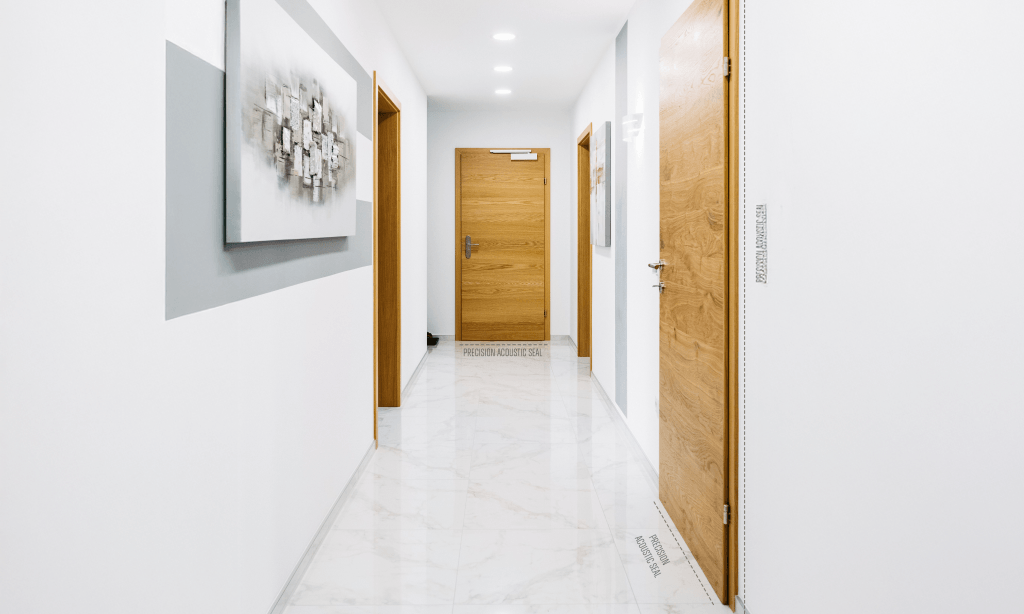
In modern apartments, controlling noise transmission across rooms is essential, becoming a necessity rather than a luxury. In a home with compact layout, shared walls, and high occupancy, sound transmission between rooms can affect privacy and often be disturbing. This is where the need for a sound proof door for home with optimized acoustic performance depends on the complete door system.
An acoustic wooden door is a complete door system that includes door leaf, frame, seals, and hardware which work together to control sound leakage. This kind of door is engineered specifically to reduce sound transmission with controlled sealing, density, and precise installation. Wesmarc Doors offers system-based solutions that are significantly different from basic door sound proofing approaches.
Understanding Sound Transmission in Door Systems
Sound travels through the door in two ways:
- Air gaps (perimeter leakage)
- Material transmission (through the door leaf)
Most doors have uncontrolled gaps between the door leaf and frame, resulting in transmission of sound through the door.
A door that is engineered to provide acoustic insulation focuses on:
- High-density construction of core to minimize transmission of sound
- Perimeters are sealed to eliminate leakage of air
- No alignment issues between the leaf and frame
The above three parameters are essential to follow to ensure the door works efficiently as a soundproof door for home.
Core Construction and Material Density
The door leaf is of significant importance when it comes to minimizing sound passing through air. For instance, engineered solid core construction is sturdy, reliable and durable directly enhancing sound insulation.
An acoustic wooden door makes use of high density infill materials that are manufactured by bonding several layers with PUR glue ensuring there are reduced internal voids. This type of construction enhances resistance to sound waves that pass through the door.
Perimeter Sealing and Gap Control
Perimeter sealing is an important aspect of door sound proofing that determines how well the door closes against the frame, thereby impacting acoustic performance.
A system-based sound dampening door incorporates:
- Extruded acoustic seals along the perimeter of the frame
- Proper compression of the door when its closed
- Ensuring consistent contact with no gaps between door leaf and the frame making for an effective soundproof door for home.
Along with this, flush-fit installation is also an important aspect that ensures there is no misalignment or gaps that are commonly seen in conventional installations.
Frame Integration and Structural Alignment
Acoustic performance isn’t just pertaining to door leaf, but is also important when it comes to the frame as it helps maintain system integrity.
A full wall wrap frame system ensures:
- Proper, even distribution of load
- Provides stable anchor with the wall
- There is minimized transfer of vibrations
When the frame and door leafs are aligned with precision, there are no uneven gaps acting as a sound proof door.
With poorly installed frames and door leaf, the door can experience:
- Uneven pressure points
- Inconsistent sealing
- Increased sound leakage
Hardware and Closing Mechanism Performance
Hardware influences how the door maintains its acoustic seal and minimizes noise transmission. Certain important hardware components like EN-rated mortise locks, 6-pin euro cylinders, adjustable hinges (2E / 3E) ensure the door closes with proper alignment and maintain contact pressure over time. With adjustable hinges that allow for fine-tuning, the door can perform even after prolonged use.
Practical Limitations: What Acoustic Doors Can and Cannot Do
Even with acoustic wooden door, there is a possibility that complete elimination of sound is not possible but only helps reduce noise transmission.
It is important to control noise efficiently with implementation of high-density engineered door leaf, accurate perimeter sealing and properly aligned frame system.
Acoustic wooden door specification when integrated with engineered core density, parameter sealing system and proper frame alignment, and hardware precision ensures consistent performance. With a design adhering to a system-led approach, Wesmarc Doors provides sound dampening door that are treated as complete door systems thereby reducing noise between rooms while maintaining long-term usability and structural stability.

