
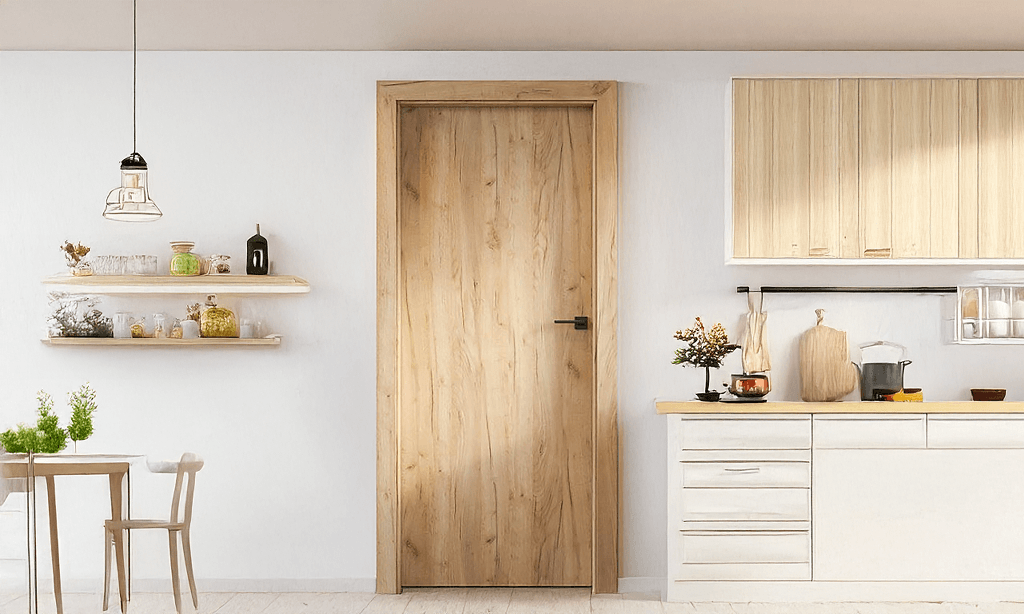
The right wooden door for kitchen India is one that is an engineered wood core door with CPL finish and PUR-sealed edges. These doors are specifically manufactured in factory controlled environments under high pressure and temperature to withstand presence of moisture, humidity, steam and withstands kitchen heat exposure. This helps in preventing swelling and warping of doors while being easy to clean and maintain. These doors are meant to last for over 20-30 years and are durable.
A kitchen is one of the most demanding spaces that are heavily used in an Indian home. With a variety of cooking happening every day, to the presence of heat, steam, oil splatter, and humidity, there is always a stress on surfaces around making it stressful. This is where the need for choosing the right wooden door for kitchen India comes from. The use of poor quality doors can result in swelling, peeling, discoloration with the door sticking over a few years. Engineered CPL doors that are crafted to withstand these conditions without compromising on their visual appearance.
Why Kitchen Doors Fail Faster Than Any Other Door in Your Home
Kitchen doors often are damaged given the presence of heat and moisture which affect the edges. Unsealed board absorbs steam and begins to delaminate in just 2-3 years. Even PU painted surfaces soften near cooking zones and may bubble in higher temperatures. Solid wood also tends to expand during repeated humidity cycles, resulting in sticking, warping as well as yellowing of surface.
The 5 Properties a Kitchen Door Must Have
When it comes to kitchen door design in wood, it is essential the doors have following properties.
| Property | What to Look For | What to Avoid |
| Heat Resistance | CPL or HPL finish | PU paint near stoves |
| Steam Resistance | PUR-sealed edges | Unsealed MDF |
| Scratch Resistance | EN rated CPL | Soft painted surfaces |
| Easy Cleaning | Matte sealed surface | Heavy textured grains |
| Dimensional Stability | Engineered wood core | Solid wood swelling |
Kitchen Door Material Comparison – Which Core Holds Up?
| Feature | CPL Engineered | PU Painted |
| Heat Resistance | Excellent | Moderate |
| Steam Resistance | Excellent | Moderate |
| Scratch Resistance | Excellent | Poor |
| Maintenance | Zero | Repaint |
| Lifespan | 20–40 years | 3–5 years |
For Indian kitchens, engineered wood doors with CPL finishing are the ideal choice to understand what CPL veneer is and its key benefits before making your final decision. Given the strong sealing across all edges which prevents ingress of moisture and steam. These doors are easy to maintain and clean.
Kitchen Zone Risk Map – Where Is Your Door?
The wooden door near the stove area must have additional protection. Doors placed within the range of 600mm from the burner edge must ideally be manufactured with use of CPL with PUR sealing. Even the doors placed by the sink must be resistant to moisture given the presence of water around continuously., in addition to steam and humidity throughout the day.
| Kitchen Zone | Door Recommendation |
| Adjacent to stove | CPL engineered + PUR seal |
| Near chimney | Heat resistant wooden door for kitchen use |
| Sink area | Moisture-proof sealed door |
| Pantry zone | Standard engineered CPL |
The Best Wooden Door Material for Kitchen India – CPL Explained
CPL doors are one of the most preferred choices when it comes to choosing the best kitchen door material India given its structural integrity, durability, versatility in designs in addition to visual appeal. CPL surfaces demonstrate strong resistance to heat and abrasion. PUR adhesive bonding further improves edge stability against steam exposure.
CPL doors from Wesmarc are preferred for modular kitchens and explore the best door types for kitchen entrances to find the right fit for your kitchen layout. under defined pressure and temperature. This results in engineered laminated wood doors with CPL veneer finishing. The doors come with four-edge sealing providing long lasting stability. The finish is uniform, resistant to scratches without the need for repainting or polishing. — including engineered laminated wood, Italian CPL veneer, and four-edge sealing that improves long-term dimensional stability and climate resistance.
Kitchen Door Swelling Prevention – Complete Checklist
One can enhance kitchen door swelling prevention by following the below:
- Go for factory finished engineered wood door with CPL finishes than solid wood
- Ensure all four edges are sealed using PUR adhesive.
- Maintain ventilation below 65% RH
- Install a bottom sweep to prevent moisture pooling
- Keep a gap of 5–7mm gap between the floor and shutter
- Periodically inspect all seals and hardware, especially before monsoon season
- Avoid use of raw MDF near cooking zones
These measures help reduce kitchen door delamination in India conditions caused by poor sealing.
A kitchen door is always exposed to the presence of heat, humidity, oil exposure, and daily heavy use which means one must choose the right type of door to ensure they are durable and long lasting. A standard painted door, polished door or solid wood door fails when used in the kitchen as they are not resistant to moisture and heat and get damaged in a few years. On the contrary choosing engineered wood, CPL veneer doors with PUR-sealed construction are apt for use in a kitchen. Wesmarc offers steam-resistant door India that are durable, long lasting for about 20-30 years, and are easy to clean and maintain making them apt in Indian kitchens.

