
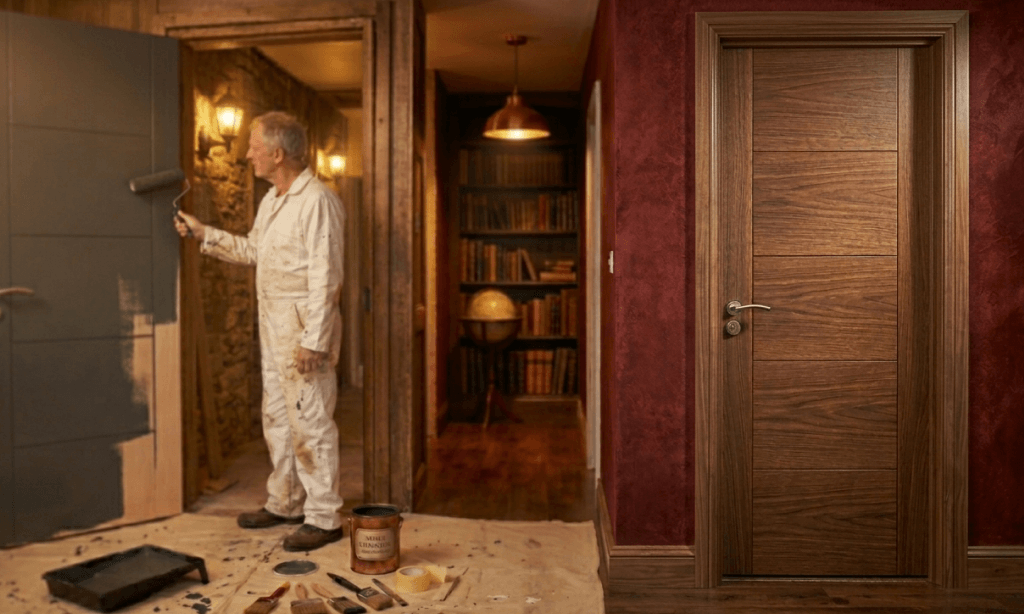
If you are looking for a door for your home and have come across different doors and want to compare between a CPL veneer door vs a PU painted door, then commonly evaluated aspects include durability and maintenance that determine the real difference. CPL (Continuous Pressure Laminate) veneer doors provide a factory-bonded, scratch-resistant, and UV-stable surface that typically has a lifespan of 15–20 years, whereas PU paint doors that are customisable can chip, turn yellow, and would need periodic repainting every 3–5 years.
What Is CPL Veneer Finish? The Modern Door Surface Technology
A CPL veneer finish door from India is an advanced engineered solution designed for enhanced durability, consistency, and long-term performance. CPL (Continuous Pressure Laminate) is manufactured using multiple layers of virgin kraft sheets and resin composites learn more about CPL veneer benefits and applications before making your door choice. The surface is bonded onto a high-density engineered deck using PUR adhesives, helping resist moisture, water, heat, scratches, and cracks.
Factory finished doors from reputed brands like Wesmarc Doors feature door surface protection that helps in maintaining uniform texture, colour consistency, and precise calibration across all doors.
Why CPL Is Called “Italian Veneer”
- Superior-quality CPL sheets are typically sourced from Italy, Germany, and Turkey.
- These veneer sheets are manufactured to mimic the natural wood grain texture.
What Is the PU Painted Door Finish?
PU (Polyurethane) painted doors make use of two-component spray coatings that are applied in multiple layers.
- This process typically makes use of primer, base coat, and topcoat applied in 3–5 coats and offers unlimited colour options in gloss, matte, and satin finishes.
- Most often, dust free spray is applied on a PU painted door, which adds some variation.
- Over a period of time
CPL Veneer vs PU Painted Door — Complete Comparison
Upon conducting a CPL vs painted door comparison, one can see the differences in performance as below:
| Parameter | CPL Veneer Finish | PU Painted Finish |
| Durability | 15–20 years (factory bonded) | 3–5 years before repainting needed |
| Scratch Resistance | Excellent (abrasion rated surface) | Poor (chips and scratches easily) |
| UV/Sunlight Resistance | High (no yellowing) | Poor (yellows within 2–3 years) |
| Water/Moisture Resistance | High (sealed laminate surface) | Moderate (paint absorbs moisture at edges) |
| Colour Consistency | 100% uniform (factory produced) | Varies (depends on painter’s skill) |
| Maintenance | Wipe clean, zero recoating | Needs repainting every 3–5 years |
| Repairability | Easy Sanding & Re-wrapping | Wood filling, Sanding and repainting required |
| Heat Resistance | Excellent (withstands kitchen heat) | Moderate (can bubble near heat) |
| Finish Options | 200+ wood grains, solids, textures | Unlimited custom RAL colours |
| Application Quality | Factory controlled, consistent | Manual, quality varies |
| Best For | All rooms, all climates | Only when exact custom colour is mandatory |
7 Reasons CPL Veneer Beats PU Paint for Indian Doors
- CPL door finish benefits include no maintenance, no repainting or refinishing.
- The surface is resistant to scratches and wear due to heavy usage given the scratchproof door finish.
- The surface finish is maintained intact without yellowing given the heat resistance treatment.
- Sealed edges protect against absorption of moisture, thereby preventing swelling and peeling in humid climates.
5 Problems with PU Painted Doors (Why They Don’t Last)
- PU painted doors are prone to chipping and flaking at high-contact areas like edges and handles.
- These doors cannot withstand the presence of UV rays and often turn yellow.
- Another PU painted door disadvantage includes the need for frequent repainting, increasing maintenance costs.
- VOC emissions during painting can affect indoor air quality during application.
When PU Paint Is the Only Option (Limited Use Cases)
- This happens when exact RAL colour matching is required.
- Preferred often in heritage projects to restore traditional finishes.
Best Rooms for CPL Veneer Doors
| Room | Why CPL Works Best |
| Main Entrance | Scratch resistance, geometrical stable, premium woodgrain look |
| Kitchen | Heat and moisture resistant; no yellowing near the stove |
| Bedroom | Low maintenance; consistent aesthetic across all rooms |
| Bathroom (adjacent) | Sealed surface resists humidity better than paint |
| Children’s Room | Scratch resistance surface handles daily wear from kids |
| Office/Commercial | Uniform batch quality for multiple doors; easy cleaning |
This versatility makes CPL the best door finish in India.
When choosing doors for a home, the homeowners tend to compare CPL veneer doors vs PU painted doors and learn that CPL clearly stands out given it is a long-lasting, durable and cost-effective solution given its door surface protection. While PU Paint doors may come in a variety of colours, they turn yellow and can chip, requiring frequent repainting. When searching for the best door finish India, it is recommended to explore the CPL veneer finish doors from Wesmarc Doors given their engineered precision and premium finishes that last long.

